

It has been well documented that currently, Padel is one of the fastest growing sports worldwide. However, down at local clubs, we seem to hear individuals asking the same questions, which include: How do we score points? How do we keep track of the score, what’s the system? How is this different to Tennis?
In this piece, we will be explaining some key rules/tactics of Padel and how to approach the sport as a beginner.
We’d love to get a conversation going of different ways that people like to try and play, so forward this article onto friends/family. Let’s dive straight into it…
Firstly, Padel is a sport that is played with four players, with two players on each side of the net, making a team (two-player courts are rare, but some are available in parts of the UK including at Ribble Valley Tennis Centre, Clitheroe).
The court has a net in the middle and four glass walls, making a cube shape. The part of the court that is closest to the net is made up of a metal cage rather than glass, making shots that are played against this (after bouncing) more difficult to return as the bounce off it is less reliable.
The objective of the game is to win points against the other team, usually by forcing an error from the opposing team (one of their players hit the ball into the net or directly against the glass) or making the ball bounce twice before your opponent can hit it back.
If the second ‘bounce’ is against the side or back surface (glass or cage), then your opponents still have the chance to get the ball back into play. However, if an overhead smash, for example, bounces on the ground, hits the back glass and then bounces on the ground again, that is the opponents point.
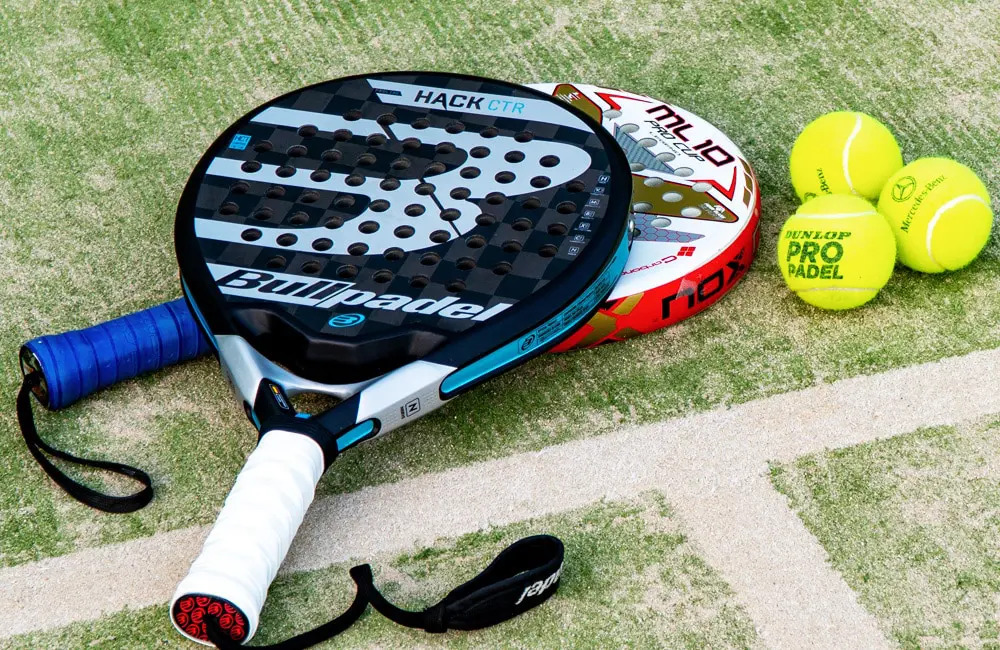
The ball cannot directly hit the opposing teams back glass or side glass, it MUST bounce before hitting it. If it doesn’t bounce before hitting it, the ball is deemed out, so the point goes to the opposing team. If the ball is on your side of the court, you CAN hit it against your own glass area (side or back) to try and manoeuvre the ball back over the net to carry on the point.
Similarly to Tennis, the scoring system works as follows: 15 (one point), 30 (two points), 40 (three points) GAME (four points), If the game is 40-40 after six points played, it goes to a ‘deuce’, in which you have to win by two clear points to win the game.
However, certain Padel competitions have a ‘golden point’ rule when a game reaches deuce, meaning that the winner of the next point (with the score at 40-40) takes that game, and you move on to the next one.
The winning team in a set is the first team to reach six games, and if the set goes to 6-6, you play a tie-break to decide the set winner. To make things confusing, the scoring in a tie-break switches to 1, 2, 3 etc. up to 7 points, and you have to win by two clear points. Keep the tie-break going if the score is 6-6, but the tie-break is over if the score is 7-5. If your team wins the tie-break, your team have won the set 7-6.
In this sport, tactically, there is a risk and reward element. For example, if you have served well (for example: close to the net, deep, in the corner) your approach will often be to follow your serve in, so you are at the net ready to punish any shorter returns.
Furthermore, the communication between you and your teammate will remain essential throughout a match. The approach from you and your teammate after one of you plays a high, deep lob may be to both rush to the net, but is not restricted to this. Padel is played in unique ways, some players will persist with a different style to others, which is what sometimes makes a dynamic, difficult to beat duo!
From personal experience, progress tracking is available in the sport through the Playtomic app. This app generates an initial level for you based on your answers to questions at the beginning, but as you and your friends begin to log multiple matches on the app, it will adjust your level and give you a ‘reliability’ percentage.
One of the most rewarding things I have found with the sport is seeing my level become more reliable as I play more often, therefore matching me up with players who are a similar ability to me. The sport is excellent as there are always ‘open matches’ available in the North-West of England (from experience), where you can book on and play with people who are a similar level to you.
For any questions or anymore information related to Padel, drop an email to: properpadel@gmail.com. We’re eager to hear your thoughts and experiences!
Subscribe to our mailing list today to stay updated with the latest content
 Proper Padel
Leave a comment